
BBQ Ontario

Materials

Freeze-thaw, not salt air.: what survives, and what only looks like it will.

Almost every failure in this category traces back to one decision made badly: the wrong material, sold to the wrong address. Here is the whole picture, including where spending more buys you nothing.

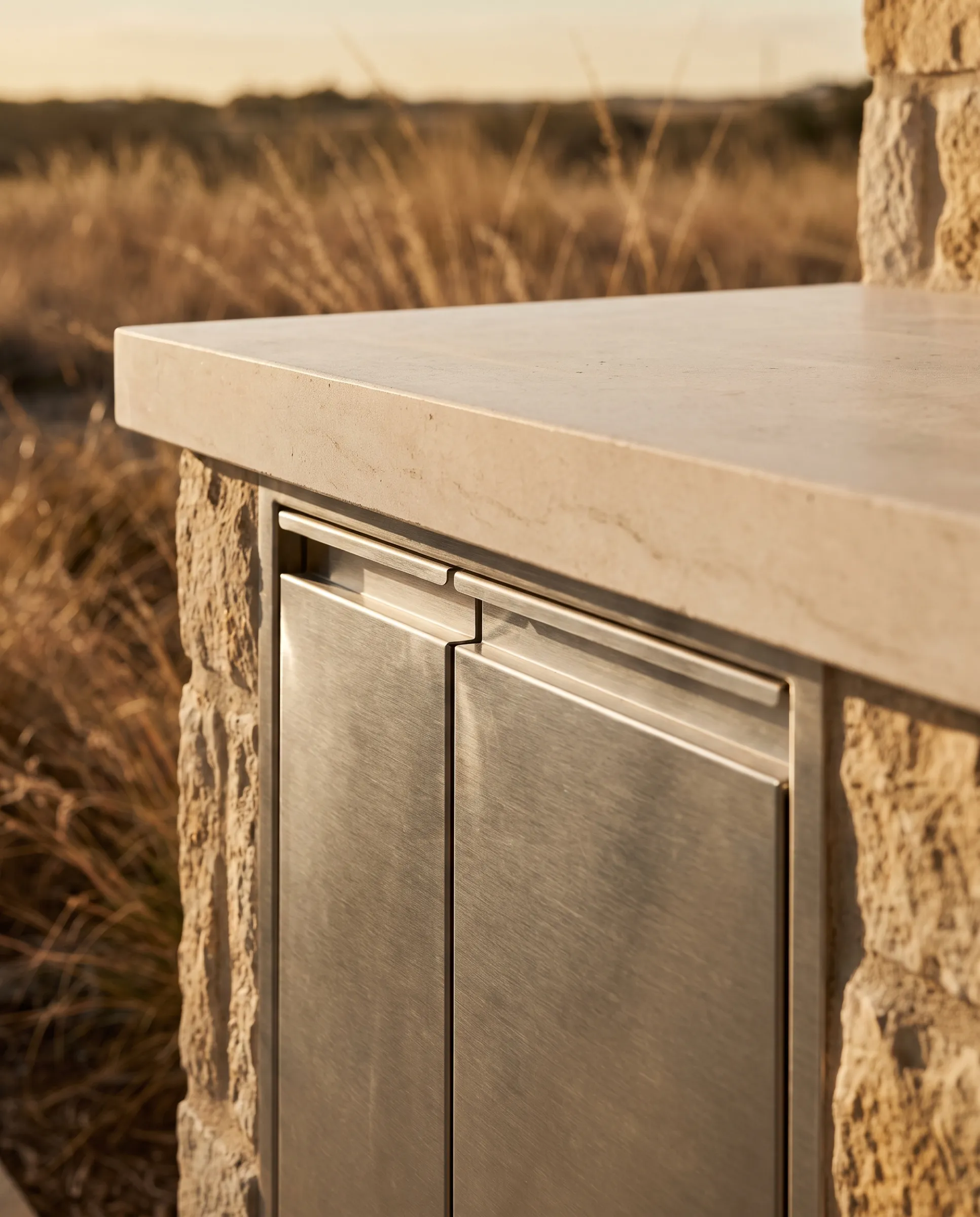
Close detail of brushed stainless cabinet fronts and stone counter

Cabinetry

304 stainless

Everywhere in Ontario — city lot, suburban deck or lakefront

The industry default for good reason: strong, clean, repairable, and widely available in every appliance size you might want.

It is not corrosion that kills it here, it is water that had somewhere to sit. A seam, a drawer bottom or an unsealed joint holds meltwater, that water freezes, and freezing water expands by roughly nine percent. Do that a hundred times a winter and the joint opens. Specify drainage and sealed seams and 304 lasts decades in this province.

Powder-coated aluminium

Covered builds, and anywhere colour matters more than metal

Will not rust. Light, quick to install, available in colours stainless cannot do.

It chips, and in Ontario a chip is not cosmetic. Water gets under the coating, freezes, and lifts it from beneath — a nick that would sit harmlessly for years in a dry climate peels through a single freeze-thaw season. Touch-up is not optional maintenance here.

Marine polymer (HDPE)

Exposed builds, docks and cottage decks with no roof over them

Genuinely inert. No rust, no rot, no corrosion, and it cleans up with soap. Excellent for door and drawer fronts.

It could not care less about frost, which is exactly why it belongs here. The catch is movement: Ontario swings roughly fifty-five degrees between January and July, and this material expands and contracts across that range more than steel does. It needs fastening detailed for movement, or it will oil-can and pull at its screws.

316 marine-grade stainless

Almost nowhere in this province — and that is the honest answer

Molybdenum in the alloy resists chloride pitting. It is what boat decks and coastal railings are specified in, for exactly this reason.

316 exists to resist chloride pitting from salt water. The Great Lakes, Georgian Bay and the Muskoka lakes are fresh water: there is no chloride load coming off them. Paying the marine premium for a lakefront cottage is buying protection against an ocean you do not have. The one place it earns its price in Ontario is a build that takes direct de-icing spray off a heavily salted arterial road or a parking structure — road salt is a genuine chloride source, and it is the only one we have.

Counters

Outdoors in Ontario the number that decides a counter is water absorption. Whatever soaks into the stone in November freezes in January, expands, and spalls the surface from the inside. Dense and near-zero absorption wins here; soft and porous does not survive, however good it looks the first summer.

Granite

Hard, heat-tolerant, forgiving. Still the default outdoors for a reason.

Porcelain slab

Almost zero absorption and excellent UV stability. Thin edges chip if the substrate is not right.

Limestone

Beautiful and soft — it stains, it absorbs, and it needs sealing on a schedule. Worth knowing before it goes down, not after.

Concrete

Fully custom shapes and integrated sinks. Hairline cracks are part of the material, not a defect.

Which one is yours?

Ontario winters run well below -20°C in Ottawa and interior Muskoka, with dozens of freeze-thaw cycles a season that stress concrete, natural stone, and any cabinetry not rated for it. Footings have to sit below the local frost line, and that line is set municipality by municipality, not province-wide — roughly 1.2 m around Toronto and the Golden Horseshoe, deeper again toward Ottawa and cottage country. Confirm the exact number with the local building department before pouring. The Great Lakes are freshwater: there's no chloride salt air the way there is on the Gulf or Atlantic coasts, so full marine-grade 316 stainless isn't the default here — 304 does the job, with 316 reserved for kitchens sitting in direct splash of a heavily salted driveway or road. What Ontario does bring: de-icing salt underfoot every winter, lake-effect humidity, and — in cottage country — a build season that effectively runs May to October. Gas hookups require a TSSA-licensed gas technician; electrical work requires an ESA notification of work, a Licensed Electrical Contractor, and an ESA Certificate of Acceptance at the end.

Find out in sixty seconds